
There is no single cold room temperature: each product has the range that preserves quality and safety, and the specification that counts is the product's and the sector's regulations. What the operator needs is to know the range for their room, measure it the right way and notice early when it drifts. Frozen goods are usually held at −18 °C or below; chilled goods sit in ranges above 0 °C defined per product. This guide brings the most used references, what makes the temperature drift and how continuous monitoring prevents the loss.
Reference ranges by product type
-
Frozen goods in general (meat, fish, ready meals)
−18 °C or below is the most used reference for frozen storage; ice cream and some fish usually call for colder. Upward swings shorten shelf life even without thawing the product.
-
Chilled meat
A range close to 0 °C, between 0 and 4 °C in most specifications, with little swing: every extra degree speeds up the loss.
-
Dairy and deli
Chilled between 0 and 5 °C, as set by the product's manufacturer; sensitive to swings and to condensation on the packaging.
-
Fruit and vegetables
The range varies a lot by product: leafy greens and roots tolerate 0 to 5 °C; tropical fruit such as bananas, mangoes and tomatoes suffer chilling injury below 10 to 12 °C. High relative humidity matters as much as temperature.
-
Drinks and products that only need to be cold
Higher holding ranges, set by the manufacturer; the focus is stability and energy use, not food safety.
-
Anterooms and handling areas
Intermediate temperatures, usually between 10 and 15 °C, to reduce thermal shock and the moisture entering the main room.
-
Blast freezers
They do not store: they bring the product temperature down fast, with air well below −18 °C and high velocity. The range is a process range, defined by the product and the freezing time.
-
Product that comes in warm (receiving)
Product arriving above the range has to be brought down to temperature, and that consumes capacity: a storage room was not built to chill warm loads in volume. Large deliveries out of range pull down the temperature of the whole stock.
Why the temperature drifts out of range
A swing is not always a fault. The controller works with a differential: it starts the compressor above the setpoint and stops it below, and defrost raises the air temperature for a few minutes. What needs attention is the trend: temperature that rises and takes long to recover after the doors, that does not reach the setpoint on the busiest days, or that swings more than it used to. The causes are the same as a cold room that is not cooling: doors and gaskets, an iced evaporator, a dirty condenser, low refrigerant, a stopped fan, a sensor out of place. The measurement history is what separates a normal swing from the start of a failure.
When monitoring makes the difference
- Rooms with nobody around at night, on weekends and on holidays
- High-value product, or product that is lost fast out of range
- More than one room or more than one site to follow
- Temperature records required for audits or customers
- A history of deviations found too late
- An operation that grew and manual checks no longer keep up
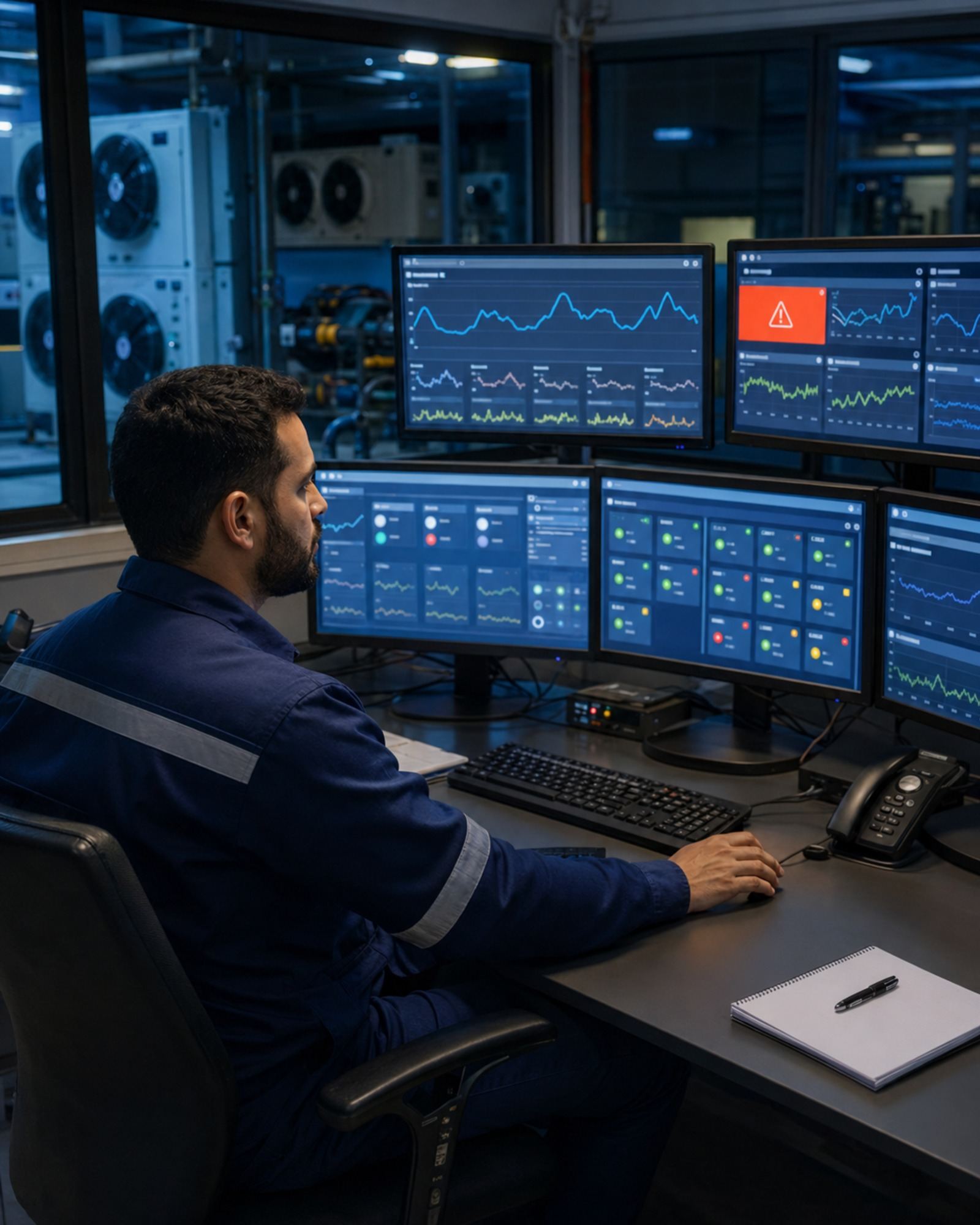
Frio Ideal's 24-hour monitoring is done by its own team, in shifts, following the operation and dispatching service when a deviation appears, as set in the contracted plan. The protocol defines each room's range, who is alerted and how fast. For a deviation in progress, the corrective on-call service runs 24/7, for systems from any manufacturer.
How to keep the temperature under control
Three habits solve most deviations: recording the temperature at fixed times (or continuously), checking the display against a reference thermometer, and treating an open door as a cost, with a curtain, short openings and planned loading. Preventive maintenance calibrates controls, tests alarms and checks that the room delivers its range with margin at peak times; each visit's report becomes the history that shows the trend before the failure.
FAQ
What is the right temperature for my cold room?
It depends on the product and the specification that applies to it. Frozen goods are usually held at −18 °C or below; chilled goods sit in ranges above 0 °C defined per product. The contractual range is the one that goes into the monitoring protocol.
The temperature swings a few degrees during the day. Is that a problem?
Some swing is normal: the controller works with a differential and defrost raises the air temperature for a few minutes. The problem is the trend: a bigger swing than usual, slow recovery after the doors, or a setpoint that is not reached at peak times.
Is the controller display enough as a record?
The display shows one sensor's reading, at one point. For a record, check against a reference thermometer and, when the operation requires it, keep a continuous record with alarms; that is what 24-hour monitoring does.
Let's assess your monitoring needs
Tell us the city and state, system type and critical operating periods.
- 24/7 emergency service
- In-house engineering in the field
- Over 15 years in operation
- Smart Cold authorized service provider